CD Review
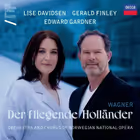
Richard Wagner: Der fliegende Holländer, Lise Davidsen, Gerald Finley
- Composer
- Richard Wagner
- Artist
- Lise Davidsen, Gerald Finley; Orchestra and Chorus of the Norwegian National Opera / Edward Gardner
- Label
- Decca
- Catalogue
- 487 0952
Lise Davidsen and Gerald Finley star in Der fliegende Holländer, Richard Wagner’s early opera about a sea captain condemned to sail forever unless he can find a woman’s faithful love, recorded with the Orchestra and Chorus of the Norwegian National Opera under Edward Gardner and released on Decca. It won the Gramophone Opera Award in 2025.
About the opera
Der fliegende Holländer, first performed in 1843, sits at an early, still-transitional point in Wagner’s development — closer in structure to the numbers-based opera of his contemporaries than the continuously through-composed music dramas he would go on to write, while already showing the thematic preoccupations (redemption, self-sacrifice, obsessive love) that would define his mature work. Senta, the Norwegian sea captain Daland’s daughter, becomes fixated on the legend of the cursed Dutchman before he ever appears in person, and her willingness to sacrifice herself for a man she has never met drives the opera’s final resolution.
About the performers
Lise Davidsen, the Norwegian soprano who sings Senta, has established herself over the past decade as one of the leading dramatic voices of her generation, with a repertoire built substantially around exactly this kind of large-scale Wagner and Strauss writing. Gerald Finley, the Canadian bass-baritone singing the title role, brings a similarly significant international reputation across both German and other core operatic repertoire. Recording the opera with the Norwegian National Opera’s own orchestra and chorus under Edward Gardner, the company’s music director, rather than assembling a one-off studio ensemble, gives the performance the cohesion of a genuine working company rather than a gathering of guest artists for a single recording date.
Why this pairing of voices matters
Davidsen and Finley’s international profiles mean this recording carries weight beyond a typical studio Wagner opera release — both are singers whose live performances in this repertoire are closely followed, and a studio recording captures a version of their interpretations unconstrained by the specific staging choices of any one production. For an opera that’s had a comparatively smaller recorded discography than Wagner’s later, more frequently staged works, a recording featuring voices of this stature is a genuine event for the work’s own reception rather than simply another addition to an already-crowded catalogue.
About the award
The Gramophone Opera Award, one of the more competitive categories in the magazine’s annual awards given how many opera recordings — studio and live, from major and specialist labels alike — compete for a single prize each year, went to this recording in 2025. For an opera that sits earlier and less frequently performed within Wagner’s own output than his mature music dramas, winning outright against releases of far more central repertoire is a genuine marker of how highly regarded both the performances and the overall production were judged to be, rather than a reflection of Der fliegende Holländer’s own popularity relative to works like the Ring cycle or Tristan und Isolde.
About the recording’s setting
Recording an opera with the resident orchestra and chorus of the company most closely tied to the story’s own setting — a Norwegian sea captain’s legend, performed by Norway’s national opera company — gives this release a specific kind of coherence beyond the individual singers’ reputations. It reflects a broader pattern in recent studio opera recordings of favouring an existing company’s own forces, already rehearsed and cohesive as an ensemble, over assembling a one-off group of session musicians and choristers purely for a recording date.
A note on this page
This review was written fresh for mmmusic to cover a real, current recording — it isn’t part of the site’s recovered 1991–2018 archive. It’s new coverage of what’s actually being recorded and recognised today, built from independently verified facts about the recording and its performers.
Questions about this recording
What's the story of Der fliegende Holländer?
Wagner's opera about a sea captain cursed to sail the oceans eternally unless he can find a woman willing to be faithful to him until death — a redemption-through-love theme Wagner returned to across much of his later work.
Why is this recording significant?
It's an early Wagner opera, less continuously through-composed than his mature music dramas, performed here by two of the leading Wagnerian voices of their generation — Lise Davidsen as Senta and Gerald Finley as the Dutchman.
Where was this recorded?
With the Orchestra and Chorus of the Norwegian National Opera under its music director Edward Gardner, reflecting Davidsen's own Norwegian background and Gardner's tenure leading the company.
Is this recording still available to buy?
Yes — Decca's catalogue number 487 0952 remains findable through the label and classical retailers. We don't run an in-house shop, so we link out to Amazon and Discogs below.


