CD Review
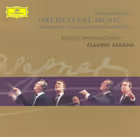
Wagner: Orchestral Music from Tannhäuser, Tristan und Isolde and Parsifal
- Composer
- Wagner
- Artist
- Berlin Philharmonic Orchestra / Claudio Abbado
- Label
- Deutsche Grammophon
- Catalogue
- 474 377-2
- Reviewed by
- Sandy Matheson
Having spent several paragraphs jeering at Parsifal’s plot, characters and libretto, Monsieur Croche (aka Claude Debussy) was forced to acknowledge that “Parsifal … is incomparable and bewildering, splendid and strong. Parsifal is one of the loveliest monuments of sound ever raised to the serene glory of music.” Latter-day Croches will find much to admire in Claudio Abbado’s Wagner album, the centrepiece of which is a mostly wordless “suite” drawn from Act III of Parsifal. In the early days of recorded music, opera-lovers had to make do with individual arias, overtures and what Leopold Stokowski called “symphonic syntheses”. Perhaps in these days of cutbacks in the classical record industry, we will be seeing a revival of this tradition.
The problem with Wagnerian “bleeding chunks” is that Wagner’s thought was essentially symphonic, and his scores do not take well to being cut about. A small but significant example occurs at the end of the Act I Prelude, when Abbado employs the “concert ending”, a conventional resolution into the tonic. Surely the point about the Prelude is that it doesn’t resolve; the resolution doesn’t occur until the end of the opera. Later in the suite there is a cut from the start of Amfortas’s “Ja, Wehe! Wehe! Weh über mich!” monologue and his final confrontation with the Grail Knights to the appearance of Parsifal with the spear. The resolution is too easily achieved.
On the other hand, I’m grateful to have an example of Abbado’s searching, spiritual Wagner on record. Apart from a long-time interest in Lohengrin, resulting in an admirable recording in 1994, Abbado has performed very little Wagner until recently. What a pity that he has waited until so late in his career before exploring a repertoire for which his gifts are particularly suited, especially as he was the music director of an orchestra with a magnificent Wagner heritage for ten years or more! The excerpts from Tristan, lean and nervy in the manner of Carlos Kleiber, are exceptionally fine here. He is giving some performances of Act II of Tristan in Lucerne this summer; I hope that DG will be on hand to record it. The Tannhäuser overture, grandly sounded out by the Berliners, is unlikely to influence potential purchasers one way or the other. Festival-goers will want to have this souvenir of Abbado’s memorable Edinburgh Parsifal, sharp-eared listeners might recognise the amazing Monsalvat bells in the Transformation Music!
A note on this page
Originally published by Sandy Matheson, recovered from mmmusic's own archive and reproduced here as the critic wrote it.
Questions about this recording
What's on this recording?
Orchestral excerpts from three Wagner operas: the Tannhäuser overture, a mostly wordless 'suite' drawn from Act III of Parsifal, and excerpts from Tristan und Isolde, played by the Berlin Philharmonic under Claudio Abbado.
Why is it notable that Abbado recorded this programme?
Abbado had performed very little Wagner across his career up to this point, aside from a well-regarded 1994 Lohengrin recording, despite a decade or more as music director of an orchestra with a major Wagner tradition, making this a comparatively late and unusual entry into the repertoire for him.
What's the issue with 'bleeding chunks' of Wagner played as concert excerpts?
Wagner's musical thought is essentially symphonic and continuous, so cutting extracts out of their full operatic context, as this disc does, can blunt moments that only resolve properly across the whole act or opera, a tension the review discusses directly with specific examples from the Parsifal suite.
Is this recording still available to buy?
Yes, Deutsche Grammophon's catalogue number 474 377-2 remains findable through classical retailers. We don't run an in-house shop, so we link out to Amazon and Discogs below.


