
CD Review
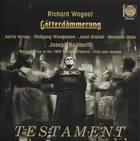
Wagner: Götterdämmerung, Astrid Varnay, Wolfgang Windgassen
- Composer
- Wagner
- Artist
- Astrid Varnay, Wolfgang Windgassen; Bayreuth Festival Chorus & Orchestra / Joseph Keilberth
- Label
- Testament
- Catalogue
- SBT4 1393
- Reviewed by
- Sandy Matheson
For many collectors, the revelation of Testament’s 1955 Bayreuth Ring will not be the singing of Varnay, Windgassen and Hotter, hugely impressive as they are, but the conducting of Joseph Keilberth. Critics have often dismissed him as a kapellmeister-ish figure, and while that may have been justified by some of his work as a concert music conductor, his recorded legacy reveals him to have been one of the most important opera conductors of the century. (Besides the 1955 Ring, you might check out his electrifying studio recording of Freischütz, the Walhall set of Oberon, the Bayreuth Flying Dutchman (a superb transfer of which is available on Testament) and Orfeo’s Vienna State Opera Arabella with Lisa della Casa. There are also two other Bayreuth Rings, both in decent sound.) Wieland Wagner chose him alongside Knappertsbusch, Clemens Krauss and Karajan to re-establish the reputation of Bayreuth after the war.
By 1955, he had been conducting The Ring for twenty years and his interpretation was pretty settled; its pacing is almost identical to the 1953 performance (available on Andromeda). The principal difference between the new Testament set and the various Bayreuth Rings from this period is the spectacular, Decca-engineered sound. The pitch-black, sulphurous orchestration at the opening of Act II sounds bottomlessly deep, while few recordings of any period can match the ferocity of Hagen’s Vassals scene as caught here. Josef Greindl (the Hagen) could sometimes be a rather unimaginative singer, often relying on sheer bulk to see him through; inspired by Keilberth, he turns in a tremendous performance. Gustav Neidlinger made Alberich his own during the 1950s, and his incisively-sung study in malevolence has never been approached since. If anything, Windgassen’s Siegfried is even better than it had been two years earlier; the occasional rhythmic unsteadiness has almost disappeared, while he remains as vocally tireless as before.
Lucky Bayreuth regulars of this period could compare and contrast Astrid Varnay’s fabulously-voiced Brünnhilde with Martha Mödl’s very different but equally impressive interpretation. Varnay appeared on this occasion, and she is magnificent. Elsewhere we find such artists as Hermann Uhde (Gunther), Greta Brouwenstijn (Gutrune) and Maria von Ilosvay, who as Waltraute really makes sparks fly in her scene with Brünnhilde. The Norns are excellent (von Ilosvay doubles up as the First Norn); I’ve heard less fluttery Rhinemaidens, but then again I’ve heard much worse! The Bayreuth orchestra is never less than thrilling; they used to say that “Keilberth’s Rhine Journey is made by fast steamer,” and with good reason, it goes like the clappers! The Funeral March is raw and savage, with a prodigious-toned Principal Trumpet. The issue of Götterdämmerung completes one of the two or three indispensable Rings on record, and arguably it is the finest of all.
A note on this page
Originally published by Sandy Matheson, recovered from mmmusic's own archive and reproduced here as the critic wrote it.
Questions about this recording
Why is this release significant?
It's the first-ever release of Joseph Keilberth's live 1955 Bayreuth Festival recording of Götterdämmerung, the final opera in Wagner's Ring cycle, in spectacular Decca-engineered stereo sound.
Who is Joseph Keilberth?
A conductor sometimes dismissed as merely a workmanlike kapellmeister figure, but whose recorded legacy, including this Ring cycle, reveals him as one of the most important opera conductors of the 20th century; Wieland Wagner chose him alongside Knappertsbusch, Clemens Krauss and Karajan to help re-establish Bayreuth's reputation after the Second World War.
Who are the principal singers?
Astrid Varnay as Brünnhilde and Wolfgang Windgassen as Siegfried lead a cast that also includes Josef Greindl as Hagen and Gustav Neidlinger as Alberich.
Is this recording still available to buy?
Yes, Testament's catalogue number SBT4 1393 remains findable through classical retailers. We don't run an in-house shop, so we link out to Amazon and Discogs below.


