CD Review
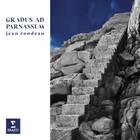
Various composers: Gradus ad Parnassum, Jean Rondeau, harpsichord
- Composer
- Various (Palestrina, Fux, Haydn, Mozart, Beethoven, Clementi, Debussy)
- Artist
- Jean Rondeau, harpsichord
- Label
- Erato
- Catalogue
- 5054197416170
Jean Rondeau’s Gradus ad Parnassum, released on Erato in 2023, is built on a deliberately provocative premise: taking a single 18th-century-style harpsichord, built in 2006 by Jonte Knif and Arno Pelto, through four centuries of keyboard repertoire, much of it written for instruments the harpsichord was never meant to imitate. Beethoven, Mozart, Clementi and Debussy all wrote for the piano’s dynamic range and sustain, neither of which a harpsichord can produce. Playing their music on an instrument that predates or sidesteps that technology is either a category error or a genuinely interesting question about what actually survives when you strip a piece back to pitch, rhythm and articulation. Critical reaction leaned toward the latter: Gramophone called the record “a triumph,” and the New York Times described it as “quietly audacious.”
About the programme
The title borrows from Johann Joseph Fux’s 1725 counterpoint treatise Gradus ad Parnassum (“Steps to Parnassus”), a foundational teaching text for generations of composers including Haydn, Mozart and Beethoven, all of whom studied from it directly or through its influence. The phrase was borrowed again a century later by Muzio Clementi for his own Gradus ad Parnassum, a set of piano studies, and again by Debussy, whose Doctor Gradus ad Parnassum, the sardonic opening movement of Children’s Corner, pokes gentle fun at exactly this kind of pedagogical exercise. All three “Gradus” works appear on the disc alongside music by Palestrina, Haydn (a movement from the Divertimento in A flat, Hob. XVI:46), Mozart (the Fantasia in D minor K.397, the slow movement of the Sonata in C K.545, and the Chaconne K.403/2) and Beethoven (the Prelude in F minor WoO 55), framed at each end by Rondeau’s own ricercars in the style of the 16th-century organ tradition. It’s less a conventional recital than a constructed argument about where craft, teaching and personal interpretation intersect, a theme reinforced by moving repertoire clearly written for one instrument onto another entirely.
About the performer
Jean Rondeau built his reputation quickly: he won the International Harpsichord Competition in Bruges, one of the most prestigious events in early keyboard performance, in 2012, at 19. Since signing to Erato (part of Warner Classics), he’s built a catalogue that regularly steps outside the harpsichord’s traditional early-music repertoire, treating the instrument as a live interpretive tool rather than a museum piece restricted to its own historical period. Gradus ad Parnassum is one of the clearest statements of that approach: a specialist instrument taken deliberately into repertoire that “belongs” to the piano, testing what’s actually essential in the writing once the instrument itself is no longer doing the expressive work a pianist would rely on.
About the recording itself
The disc was recorded at the Salle de Musique in La Chaux-de-Fonds, Switzerland, a venue with a long-standing reputation among European labels for chamber and solo recordings, on Rondeau’s own harpsichord, a modern instrument built in the historical French style rather than an antique original, which gives the recording a more consistent and controllable sound than many period-instrument sessions relying on borrowed or restored 18th-century harpsichords. Framing the whole sequence with Rondeau’s own ricercars, written in the manner of the 16th-century organ tradition that predates even Fux’s treatise, extends the “steps to Parnassus” idea back a further two centuries before the programme proper begins, a structural choice that turns the album into something closer to a guided historical argument than a simple recital sequence.
A note on this page
This page is new writing, not part of the archive recovered from the original 1991–2018 mmmusic shop, the site closed before this recording existed. It’s fresh coverage of a real, current release, built from verified facts about the recording, its programme and its performer, in the same spirit as the reviews the shop used to publish.
Questions about this recording
What does the title Gradus ad Parnassum mean?
"Steps to Parnassus", the title of a famous 18th-century counterpoint treatise by Johann Joseph Fux, later borrowed by Clementi for a set of piano studies and by Debussy for the opening movement of Children's Corner, both of which appear on this disc. Rondeau uses it as the organising idea for a programme about learning and technique across centuries.
Is this really all played on a harpsichord?
Yes, including music by Beethoven, Mozart, Clementi and Debussy that was written for piano, not harpsichord. Rondeau plays it on a single instrument built in 2006 by Jonte Knif and Arno Pelto, recorded at the Salle de Musique in La Chaux-de-Fonds, Switzerland.
Who is Jean Rondeau?
A French harpsichordist who won the International Harpsichord Competition in Bruges in 2012 at the age of 19, and has recorded for Erato/Warner Classics since, often taking the instrument into repertoire well outside the usual early-music harpsichord canon.
How was this album received critically?
Gramophone called it "a triumph" and the New York Times described it as "quietly audacious", both real, published assessments of the recording, not paraphrase.
Is this recording still available to buy?
Yes, Erato's catalogue number 5054197416170 remains findable through classical retailers. We don't run an in-house shop, so we link out to Amazon and Discogs below.


