CD Review
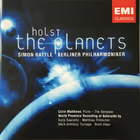
Holst: The Planets · Asteroids, Berlin Philharmonic Orchestra / Rattle
- Composer
- Holst
- Artist
- Berlin Philharmonic Orchestra / Rattle
- Label
- EMI
- Catalogue
- 3 69690 2
- Reviewed by
- Sandy Matheson
Sir Simon Rattle has always insisted on a high-fibre diet for his audiences. “You want Mahler 2? Well, let’s do Berio’s Sinfonia as well, it quotes Mahler’s scherzo. Daphnis et Chloé? How about Messiaen’s Et exspecto resurrectionem mortuorum as a prelude?” Since going to Berlin, he hasn’t exactly shied away from popular repertoire, his recent discography includes Carmina Burana and La mer, but his pedagogic instincts haven’t deserted him. When he restudied Holst’s Planets after a 20-year gap, he not only decided to include Colin Matthews’ by-now familiar Pluto, The Renewer, but to create an entire evening of “space music” by commissioning a quartet of “Asteroids”. The result, recorded live in Berlin, has just been released.
The stand-out Asteroid is Kaija Saariaho’s Toutatis. Although brief in duration (this performance lasts 4’36”) it has a massive sense of scale. It’s space-age Sibelius. Mark-Anthony Turnage’s apocalyptic Ceres is another strong piece, the asteroid in question whumping into the earth, bringing about Armageddon. Brett Dean’s Komorov’s Fall, a vivid memorial to the first cosmonaut to die in space, continues the generally tragic view of space in these works. Only one of the Asteroids fails to convince; I’ll not be returning to the grey concrete world of Matthias Pintscher’s towards Osiris any time soon. I really warm to the idea of Rattle’s Ad Astra project though, and there’s nothing to stop him making it open-ended. I’d certainly welcome more pieces along these lines.
As for The Planets itself, this is a far more engaging account than his old Philharmonia version. Apparently, he was pushed into doing the older recording against his will, and it shows, despite fine playing from the Philharmonia (and the wonderful acoustic of the Queensway Hall), that 1978 performance has never had many admirers, and Rattle himself claims to have fallen asleep while listening to the test pressing. He said recently that “(The Planets) is very European, what’s English about it, which is Jupiter, is very distinctly in inverted commas”. Quite a bit of The Planets sounds English to me, Mercury and Uranus both feature modal, folk-like material so beloved of English composers of the period, but Rattle’s right, what’s interesting about it is what’s not English. Schoenberg’s Five Pieces for Orchestra is surely somewhere in the background of Neptune, and of course Debussy’s influence is all over The Planets. Perhaps it’s the outward-looking nature of this score that lends it international appeal, it’s one of very few British compositions that are programmed with any regularity on the continent.
Starting with a brutal, bluntly-phrased Mars, the Berliners play it fabulously, the focus and concentration of their playing in Mercury is astonishing, and those amazing Berlin double-basses make Saturn a tremendous experience. The recorded sound is pretty good, although the horns sound rather shy, which I’m sure they weren’t, I’ve noticed this in other records from the Philharmonie.
A note on this page
Originally published by Sandy Matheson, recovered from mmmusic's own archive and reproduced here as the critic wrote it.
Questions about this recording
What are the 'Asteroids' paired with The Planets on this disc?
Four newly commissioned orchestral pieces, Kaija Saariaho's Toutatis, Mark-Anthony Turnage's Ceres, Brett Dean's Komarov's Fall and Matthias Pintscher's towards Osiris, recorded live in Berlin, plus Colin Matthews's earlier Pluto, The Renewer.
Which of the new Asteroid pieces does the review rate most highly?
Kaija Saariaho's Toutatis, described as having a massive sense of scale for its brief 4'36'' duration, 'space-age Sibelius', with Turnage's Ceres and Dean's Komarov's Fall also praised.
How does this compare to Rattle's earlier Planets recording?
Far more engaging, according to the review, his 1978 Philharmonia version was reportedly made against his own will and has never had many admirers; Rattle himself has said he fell asleep listening to its test pressing.
Is this recording still available to buy?
Yes, EMI's catalogue number 3 69690 2 remains findable through classical retailers. We don't run an in-house shop, so we link out to Amazon and Discogs below.


