CD Review
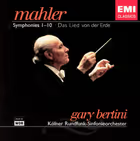
Mahler: Symphonies Nos. 1–10 (Adagio) & Das Lied von der Erde
- Composer
- Mahler
- Artist
- Various soloists and choirs; Kölner Radio Symphony Orchestra / Gary Bertini
- Label
- EMI Classics
- Catalogue
- 3 40238 2
- Reviewed by
- Sandy Matheson
Gary Bertini’s wiry frame and vigorous platform manner made him a familiar figure in Scottish musical life during the 1970s, when he held the post of Principal Guest Conductor of the SNO, during which time he was regarded with great affection by Scottish audiences. One of his abiding passions was Mahler; I particularly remember a shattering performance of the Sixth Symphony with the SNO in 1976. He recorded Symphonies 1–9 along with the Adagio from the Tenth and Das Lied von der Erde with the Cologne Radio Symphony Orchestra between 1984 and 1991, and EMI has released them in a budget-priced box as a memorial to him; he died in March 2005. It will be welcomed by his many admirers, and by Mahlerians in general, for this is one of the most satisfying Mahler surveys on the market.
His orchestra is a very good one, with a typically German sound; the woodwind and brass principal playing is uniformly excellent. Among the high points of this cycle are the choral symphonies and Das Lied. Bertini was a conductor who understood how to get the best out of a chorus, and the thrilling singing on offer here is very good indeed. The best performances are the last to be recorded: that is to say, Symphonies 1, 2, 8, 9 and Das Lied von der Erde, the account of Das Lied, with Marjana Lipovšek and Ben Heppner as soloists, rivals the very best on record. Most of these were recorded live during a Mahler festival in Suntory Hall, Tokyo. The earliest in the series, Symphonies 3 and 6, are marginally less impressive, partly due to the unflattering acoustic of the Philharmonie in Cologne. Like almost everyone who conducts the opening Adagio of the Tenth Symphony while rejecting one or other of the completions, Bertini sounds rather unconvincing. Symphonies are narratives, and with no context the temptation to overplay this movement is one that Bertini doesn’t entirely avoid.
In general, his Mahler is structurally coherent, admirably free of egotism, while always sharply characterising and animating the music. As I’ve indicated, the recorded sound varies somewhat, but is mostly fine. EMI’s decision to split several of the symphonies between discs is a shame, the break before the last movement of the Fourth (a strong, eventful interpretation, by the way) is a Very Bad Idea. The set comes with texts and a highly contentious essay by Kyo Mitsutoshi, who praises Bertini to the skies while breezily trashing the reputations of such no-hopers as Klemperer, Karajan and Michael Gielen, who (collectors will be alarmed to learn) “juxtaposed timbres like an array of grey cement blocks.”
A note on this page
Originally published by Sandy Matheson, recovered from mmmusic's own archive and reproduced here as the critic wrote it.
Questions about this recording
When were these Bertini Mahler recordings made?
Between 1984 and 1991, with the Cologne (Kölner) Radio Symphony Orchestra, most of the later recordings, including Symphonies 1, 2, 8, 9 and Das Lied von der Erde, were taped live during a Mahler festival in Suntory Hall, Tokyo.
Why was this box released as a memorial?
Gary Bertini died in March 2005; EMI's budget-priced 11-CD reissue of his complete Mahler cycle followed as a tribute. Bertini had also been a familiar and well-liked figure in Scottish musical life during the 1970s as Principal Guest Conductor of the SNO.
Which recordings in the cycle stand out most?
The review singles out the choral symphonies and Das Lied von der Erde as the high points, its account of Das Lied, with soloists Marjana Lipovšek and Ben Heppner, is judged to rival the very best available on record. The earlier-recorded Symphonies 3 and 6 are considered marginally less impressive, partly due to the Cologne Philharmonie's acoustic.
Is this recording still available to buy?
Yes, EMI Classics' catalogue number 3 40238 2 remains findable through classical retailers. We don't run an in-house shop, so we link out to Amazon and Discogs below.


