
CD Review
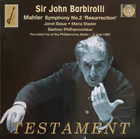
Mahler: Symphony No.2 "Resurrection", Maria Stader, Janet Baker
- Composer
- Mahler
- Artist
- Maria Stader, Janet Baker; Choir of St. Hedwig's Cathedral, Berlin; Berlin Philharmonic Orchestra / Sir John Barbirolli
- Label
- Testament
- Catalogue
- SBT2 1320
- Reviewed by
- Sandy Matheson
Due largely to record company politics (EMI already had a Mahler Resurrection with Klemperer in their catalogue, and they also wanted to keep in Karajan’s good books), only one commercial recording was ever made of Mahler with Barbirolli and the Berliners. He did, however, perform several Mahler works there in the wake of the famous Ninth Symphony recording. Luckily, these, the Second, Third and Sixth, have all been preserved on tape, courtesy of Berlin Radio. Over the years they have popped up on various ‘pirate’ labels; Testament’s release of the Resurrection is its first ‘official’ release.
It is in mono, with a significant amount of tape hiss and some odd balances, lots of harp, jumbo birch twigs in the Scherzo, almost inaudible offstage brass, but the deficiencies of the recorded sound should not deter anyone from acquiring this remarkable document. By 1965, the Berlin sound had lost much of the dark-hued, shaggy grandeur that had been its trademark in the days of Furtwängler. Yet the sound Barbirolli draws from the Berlin cellos and basses at the work’s opening had me checking whether this had been made in 1955 rather than a decade later. It’s massive, bottomlessly deep, furiously intense. Barbirolli sets a brisk pace, yet the weight of string tone is ever present.
In a number of ways, Barbirolli’s approach differs from what might be considered a ‘standard’ interpretation, although on the whole he has the text on his side. For instance, he accelerates into the molto pesante lead-in to the recapitulation; post-Bernstein, it has become usual to present this passage in massively distended form. Interestingly, I once heard Alexander Gibson opting for Barbirolli’s reading at this point, I wonder if he ever heard a Barbirolli performance. Throughout this account, there is, hurrah!, a generous larding of portamento, increasingly a frowned-on practice in modern orchestral playing, yet surely an essential element of Mahler’s style.
The presence of Janet Baker in Urlicht makes this a high point in a performance of high points. Barbirolli’s very slow tempo for this movement forces Baker to break her final phrase; her way with the text, however, is matchless, and she is in her most refulgent voice. This altogether supersedes the Stuttgart performance issued in EMI’s Great Conductors of the Century series, although that volume is worth having for other reasons. It deserves to be on the shelves of all Mahlerians.
A note on this page
Originally published by Sandy Matheson, recovered from mmmusic's own archive and reproduced here as the critic wrote it.
Questions about this recording
Why is this recording so rare?
Record company politics kept it out of commercial release for decades, EMI already had Klemperer's Resurrection in their catalogue and wanted to protect their relationship with Karajan, so only one commercial Mahler recording was ever made with Barbirolli and the Berlin Philharmonic. This live 1965 performance survived only because Berlin Radio preserved it on tape.
Is the sound quality a problem?
It's mono, with tape hiss and some odd balances (prominent harp, muted offstage brass), but the review argues the performance itself is remarkable enough that the sonic limitations shouldn't put listeners off.
What makes Janet Baker's contribution significant?
Her performance in the 'Urlicht' movement is singled out as a high point, Barbirolli's unusually slow tempo forces her to break her final phrase, but her interpretation of the text and vocal quality are described as matchless.
Is this recording still available to buy?
Yes, Testament's catalogue number SBT2 1320 remains findable through classical retailers. We don't run an in-house shop, so we link out to Amazon and Discogs below.


