CD Review
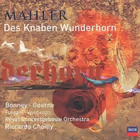
Mahler: Des Knaben Wunderhorn
- Composer
- Mahler
- Artist
- Barbara Bonney, Matthias Goerne, Sara Fulgoni, Gösta Winbergh; Royal Concertgebouw Orchestra / Riccardo Chailly
- Label
- Decca
- Catalogue
- 467 348-2
- Reviewed by
- Sandy Matheson
Riccardo Chailly seems to have taken Mahler’s famous dictum, “Tradition ist Schlamperei” (tradition is slovenliness) to heart; his recordings have been preceded by meticulous research, much of it in conjunction with Donald Mitchell, who has also written the liner notes for the series. In the case of the Wunderhorn songs, Chailly has taken note of the voice types employed by Mahler in his own performances of these works. This has resulted in a mezzo-soprano and a tenor being used in one song each, with a soprano (Barbara Bonney) and a baritone (Matthias Goerne) sharing the remaining songs, not a very practical solution in a concert situation, but perfectly feasible on record. Chailly has also devised a personal order for the songs, choosing to end with Das himmlische Leben, better known as the finale of the Fourth Symphony.
The distribution of songs between soprano and baritone is also unusual; for instance, Bonney gets Lob des hohen Verstands (she sings it with gusto) while Goerne has the lovely Rheinlegendchen, normally taken by a female voice. Both artists are in great form; I love Goerne’s bone-dry Sermon of St. Anthony of Padua to the fishes, while Bonney’s Wo die schönen Trompeten blasen is worth the price of the disc. Chailly taxes Sara Fulgoni with a very broad tempo in Urlicht, he did the same thing in his recording of the Resurrection Symphony, but the tenor option in Revelge works very well, in what turned out to be one of Gösta Winbergh’s last recordings.
Chailly secures fabulous playing from the Royal Concertgebouw. He opts for a reduced string section, allowing the characterful woodwind solos to make their full effect, and Decca’s naturally balanced recording gives a fine impression of the glorious Concertgebouw acoustic. Those of you who are following Chailly’s Mahler cycle will need no encouragement to add this to your collections; newcomers will find much to enjoy in the latest instalment.
A note on this page
Originally published by Sandy Matheson, recovered from mmmusic's own archive and reproduced here as the critic wrote it.
Questions about this recording
What research shaped Chailly's approach to this Wunderhorn recording?
Chailly worked closely with Mahler scholar Donald Mitchell, who also wrote the liner notes, and took note of the voice types Mahler himself used in his own performances of these songs when deciding how to distribute them among his four soloists.
How are the songs distributed between the singers?
Unusually, soprano Barbara Bonney and baritone Matthias Goerne share most of the songs (including some normally taken by the opposite voice type, like Goerne's Rheinlegendchen), with a mezzo-soprano and a tenor each singing just one song apiece, a distribution more practical on record than in concert.
What order does Chailly use for the songs?
His own personal sequence, ending with Das himmlische Leben, better known as the finale of Mahler's Fourth Symphony, which also sets a Wunderhorn text.
Is this recording still available to buy?
Yes, Decca's catalogue number 467 348-2 remains findable through classical retailers. We don't run an in-house shop, so we link out to Amazon and Discogs below.


