CD Review
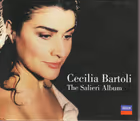
Salieri: The Salieri Album, Cecilia Bartoli
- Composer
- Salieri
- Artist
- Cecilia Bartoli; Orchestra of the Age of Enlightenment / Adam Fischer
- Label
- Decca
- Catalogue
- 475 1002
- Reviewed by
- Sandy Matheson
The operas of Salieri will be, I suspect, terra incognita to all but the most dedicated collectors of operatic rarities. Only Falstaff has attracted much attention from the record companies, with three versions currently available as well as a DVD. Most of the arias on Cecilia Bartoli’s album are new to the catalogue. As on her superb Gluck CD, she has chosen exclusively from the Italian operas; there are also operas in French and German, Salieri was an enthusiastic advocate of the establishment of a national German opera.
Although Salieri’s name will forever be associated with Mozart, much of the material on Bartoli’s CD has a stronger connection with Gluck, who was his friend and who regarded him as his true heir. Like Gluck, Salieri was most comfortable with tragic subjects. One of the highlights of Bartoli’s disc is Eurilla’s Act II recitative and rondo from La cifra, which was composed for the celebrated Adrianna Ferrarese, Mozart’s first Fiordiligi. Bartoli sings this with a full appreciation of the music’s quality; this is a distinguished piece of singing. Her characterisation of the comic numbers is, as always with this artist, full-on, larger than life and hugely entertaining. Only occasionally does her enthusiasm get the better of her; the opening aria, from La secchia rapita, finds her in eye-popping, one-double-espresso-too-many mood.
Bartoli has always been wise in her choice of accompanists. Here, she chooses the Orchestra of the Age of Enlightenment under Adam Fischer. Salieri gives his orchestra lots of opportunities to shine, and the playing of the OAE matches Bartoli’s vivid characterisations. Decca provides luxury packaging; if you have Bartoli’s Vivaldi and Gluck albums, you’ll know what to expect. Highly recommended to all admirers of great singing!
A note on this page
Originally published by Sandy Matheson, recovered from mmmusic's own archive and reproduced here as the critic wrote it.
Questions about this recording
Why is Salieri's operatic music so rarely recorded?
Only his opera Falstaff has attracted much attention from record companies, with three versions and a DVD available; most of the arias on this disc were new to the catalogue when it was released.
How does Salieri's music relate to Gluck's?
Despite Salieri's name being forever linked with Mozart, much of the material on this disc has a stronger connection with Gluck, who was Salieri's friend and regarded him as his true heir, both composers favoured tragic subjects.
What's the standout track on this recording?
Eurilla's Act II recitative and rondo from La cifra, composed for the celebrated soprano Adriana Ferrarese (Mozart's first Fiordiligi), described as a distinguished piece of singing.
Is this recording still available to buy?
Yes, Decca's catalogue number 475 1002 remains findable through classical retailers. We don't run an in-house shop, so we link out to Amazon and Discogs below.
What's the Decca catalogue number for this album?
475 1002, Cecilia Bartoli's recital of Antonio Salieri arias with the period-instrument Orchestra of the Age of Enlightenment, released on Decca.


