
CD Review
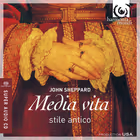
Sheppard: Media Vita, Stile Antico
- Composer
- Sheppard
- Artist
- Stile Antico
- Label
- Harmonia Mundi
- Catalogue
- HMU 807509
- Reviewed by
- James Booth
One of the great pleasures of Renaissance music is the continual unearthing of neglected masters, standing testament to the consistent standards of a golden age. And Sheppard, until the last two or three decades, certainly has been one of those neglected masters, almost totally obscured by the looming bulk of Tallis’s achievements. But thankfully this is changing, and the Gramophone award-winning Stile Antico’s new disc should certainly help speed this up.
What first strikes the listener is the sheer luxuriant richness of the sonority. This should be no surprise as Sheppard often writes in six parts with frequent subdivisions. Stylistically closer to the Eton Choirbook than contemporary continental practice, these parts intertwine through strikingly rich harmonies, daring false relations and extended forms creating a mesmeric, solemn effect. Nowhere else is this more evident than in Media Vita, an epic meditation on mortality that comes in at over 25 minutes of lush, richly detailed and moving polyphony. Gaude, gaude, gaude Maria and the Te Deum are again very impressive essays in extended polyphonic form. Also included are fine settings of English anthems and a very fine setting of The Lord’s Prayer.
These shorter works but still have that highly individual sense of contrapuntal control and opulent harmonic character that defines Sheppard’s style. Stile Antico present this music wonderfully well. Performing without a conductor and blessed with excellent intonation and clarity, they send their lines soaring through the folds of polyphonic fabric with effortless grace. It is perhaps wrong to single out anyone for praise in such a cohesive group, but the sopranos acquit themselves particularly well in challenging parts of great vocal range.
About the composer
John Sheppard’s own biography is far less documented than his music, which is itself part of why he spent so long in Tallis’s shadow. Born around 1514–15, his only firmly documented post was as Master of the Choristers at Magdalen College, Oxford, from 1543 to early 1548, before he moved on to the Chapel Royal, he’s recorded among the Gentlemen of the Chapel Royal singing at the funeral of Edward VI in 1553. In 1554 he petitioned, apparently unsuccessfully, for a Doctorate of Music at Oxford, claiming twenty years’ study of the subject and “many songs” composed; he died in late 1558 or early 1559, active right through the reign of Mary I, leaving behind a body of Latin church music that only really returned to wide attention with the historically informed performance movement decades later.
A note on this page
Originally published by James Booth, recovered from mmmusic's own archive and reproduced here as the critic wrote it.
Questions about this recording
Who was John Sheppard?
A Renaissance English composer largely overlooked until the last two or three decades, overshadowed by the reputation of his contemporary Thomas Tallis, a neglect this review notes is finally changing.
What makes Media Vita distinctive?
It's an epic meditation on mortality running over 25 minutes, written in six parts with frequent subdivisions, creating a sonority stylistically closer to the Eton Choirbook than to contemporary continental practice of its time.
Does Stile Antico perform with a conductor?
No, the group performs without a conductor, and the review singles out their intonation and clarity in achieving this despite that.
Is this recording still available to buy?
Yes, Harmonia Mundi's catalogue number HMU 807509 remains findable through classical retailers. We don't run an in-house shop, so we link out to Amazon and Discogs below.


