CD Review
Various composers: Garden of Early Delights, Pamela Thorby, recorder
- Composer
- Various (Van Eyck, Fontana, Castello, Marini, Ortiz, Dowland)
- Artist
- Pamela Thorby, recorder; Andrew Lawrence-King, harp
- Label
- Linn Records
- Catalogue
- CKD 291
- Reviewed by
- Dawn Cooke
Garden of Early Delights is a truly apt title for this charming collection of Elizabethan recorder and harp pieces, and the musicians, Pamela Thorby and Andrew Lawrence-King, form an ideal collaboration. The opening work, Recercada segunda de tenore by Ortiz, was written in 1553. It demonstrates the astounding virtuosity of the recorder and is particularly impressive in the embellishment and complex ornamentation that is so exquisitely executed by internationally-renowned Thorby.
The sleeve notes introduce the idea that the recorder is historically symbolised as a woman’s instrument associated with pastoral scenes, singing birds and played by angels, whilst the Italian harp’s seventeenth-century image is distinctly masculine, connected to images of King David and love scenes. The two instruments certainly fall into their roles in the first work. The composer intended the use of free invention and indeed Thorby is a master of this. The glissandi (called glosa) give the feeling of jazz improvisation in places, which is what the composer intended for his Trattado.
About the performers
Pamela Thorby is a British recorder player who has built a career spanning both period-instrument early music and new commissions, recording extensively for Linn across a wide historical range. Andrew Lawrence-King, her collaborator here, is a leading specialist in historical harps and directs the Harp Consort, an ensemble devoted to early repertoire for plucked strings. The pairing of recorder and harp specifically, rather than the more familiar lute or theorbo continuo, reflects the programme’s focus on repertoire genuinely associated with those two instruments in the sixteenth and seventeenth centuries, recorded at York’s National Centre for Early Music, a purpose-built venue for exactly this kind of historically informed recording.
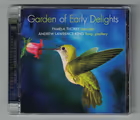
The recorder is not just represented in a virtuosic light. Schop’s Lachrime Pavaen, written in 1646, shows the melancholy side of the instrument, and here Thorby plays the tenor instrument, which has a deeper timbre and is less frilly. This is followed by Weep you no more by Dowland and offers a chance to hear delicate Baroque triple harp by itself. An added bonus (for me at least) is the beautiful front cover and informative sleeve notes. The disc was recorded at the National Centre for Early Music in York.
A note on this page
Originally published by Dawn Cooke, recovered from mmmusic's own archive and reproduced here as the critic wrote it.
Questions about this recording
What's on this recording?
Elizabethan and early Baroque works for recorder and harp, including pieces by Diego Ortiz, Jacob van Eyck, Dario Castello, John Dowland, Johann Schop, Giovanni Bassano, Giovanni Battista Fontana and Biagio Marini.
Who are the performers?
Pamela Thorby on recorder and Andrew Lawrence-King on harp, an internationally recognised pairing known for their virtuosic and imaginative early-music collaborations.
Where was this recorded?
At the National Centre for Early Music in York.
Is this recording still available to buy?
Yes, Linn Records' catalogue number CKD 291 remains findable through classical retailers. We don't run an in-house shop, so we link out to Amazon and Discogs below.


