CD Review
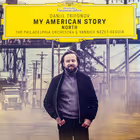
Various composers: My American Story: North, Daniil Trifonov, piano
- Composer
- Various (Tatum, Gershwin, Copland, Young/Evans, Adams, Corigliano, Grusin, Newman, Bates, Soule/Trifonov, Cage)
- Artist
- Daniil Trifonov, piano; The Philadelphia Orchestra / Yannick Nézet-Séguin
- Label
- Deutsche Grammophon
- Catalogue
- 4865757
Daniil Trifonov’s My American Story: North, released on Deutsche Grammophon in 2024, is a genuinely unusual piece of programming for a major-label classical release: Art Tatum and George Gershwin sit alongside John Cage, film composers Dave Grusin and Thomas Newman, and, least expected of all, an arrangement of “Secunda,” a theme from the video game The Elder Scrolls V: Skyrim, arranged by Trifonov himself. It’s the first instalment of a planned two-part project exploring American piano music, with a “South” volume still to come, and it earned a Presto Music Award as one of the UK retailer’s top recordings of 2024.
About the programme
The disc opens with Art Tatum’s “I Cover the Waterfront” before moving into Gershwin’s Concerto in F, performed here with the Philadelphia Orchestra under Yannick Nézet-Séguin, a substantial orchestral centrepiece rather than a token nod to American jazz-classical fusion. From there the programme moves through Copland’s Piano Variations, a Bill Evans arrangement of “When I Fall in Love” (originally composed by Victor Young), John Adams’s minimalist China Gates, John Corigliano’s Fantasia on an Ostinato, and film music by Dave Grusin (“Memphis Stomp,” from The Firm) and Thomas Newman (the theme from American Beauty). Mason Bates’s Piano Concerto, a substantial three-movement contemporary work, sits alongside all of this, and the disc closes with two different versions of John Cage’s 4’33”, the famously silent piece, framing the whole eclectic sequence with a work that asks what “American music” even means once you strip away sound itself. The Skyrim arrangement, tucked in among all of this, is the clearest signal that Trifonov isn’t building a conventional canon-and-crossover recital but something closer to a personal, genre-agnostic survey of what “American” music has actually sounded like across a century.
Copland’s Piano Variations, composed in 1930, is a useful hinge point in that sequence: it’s one of the most deliberately astringent, motivically concentrated works Copland ever wrote for solo piano, built almost entirely from a single four-note cell and worlds away from the open, folk-inflected orchestral style, Appalachian Spring, Rodeo, most listeners associate with his name. Placing it directly alongside Gershwin’s altogether more populist, jazz-inflected Concerto in F makes an implicit argument about the range of what counted as “American” concert music within a single generation of composers working in New York in the 1920s and 30s. Trifonov performs the Gershwin with a full orchestra rather than in a piano-reduction or solo-recital arrangement, treating it as an equal centrepiece rather than a crossover encore.
About the performer
Daniil Trifonov, though trained substantially in the Russian tradition, studied at the Cleveland Institute of Music in the United States, a biographical detail that gives this project’s title real weight rather than treating “American Story” as a marketing conceit. He has built one of the more prominent solo careers on Deutsche Grammophon’s current roster, and a two-part project of this scope and specificity, spanning jazz, film music, minimalism, a video-game arrangement and Cage in the same sequence, represents a considerable departure from the concerto-and-recital format that dominates most major-label piano releases. With the announced “South” volume still to come, this “North” instalment reads as a deliberately partial statement, a first half whose companion piece will presumably fill in the American repertoire this one leaves out, rather than a self-contained survey.
A note on this page
This is new writing about a real, recent recording, not part of the archive recovered from mmmusic’s original 1991–2018 run, the shop had closed years before this project existed. It’s fresh coverage extending the same factual approach the original site’s reviews took, built from independently verified facts about the programme and its reception.
Questions about this recording
What's on My American Story: North?
A wide-ranging American programme: Art Tatum's "I Cover the Waterfront," Gershwin's Concerto in F with the Philadelphia Orchestra, Copland's Piano Variations, a Bill Evans arrangement of "When I Fall in Love," John Adams's China Gates, John Corigliano's Fantasia on an Ostinato, film themes by Dave Grusin and Thomas Newman, Mason Bates's Piano Concerto, an arrangement of a theme from the video game The Elder Scrolls V: Skyrim, and two versions of John Cage's 4'33".
Is this a complete project or part of something larger?
It's the first instalment of a planned two-part project, "My American Story," with a "South" counterpart to follow, this "North" volume focuses on repertoire associated with the American North and Midwest.
What award did this recording win?
A Presto Music Award, given by the UK classical retailer Presto Music as part of its editorial selection of the year's top ten recordings for 2024.
Why would a Russian-trained pianist build a project around American music?
Daniil Trifonov trained substantially in the United States, at the Cleveland Institute of Music, and this project reflects that personal history alongside his primary grounding in the Russian piano tradition.
Is this recording still available to buy?
Yes, Deutsche Grammophon's catalogue number 4865757 remains findable through classical retailers. We don't run an in-house shop, so we link out to Amazon and Discogs below.


