CD Review
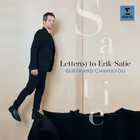
Erik Satie: Letter(s) to Erik Satie, Bertrand Chamayou, piano
- Composer
- Erik Satie
- Artist
- Bertrand Chamayou, piano
- Label
- Erato
- Catalogue
- 5054197696442
Erik Satie died in 1925, having spent much of his career being treated as an eccentric footnote to Debussy and Ravel rather than a composer in his own right, a handful of very short, very spare piano pieces (the Gymnopédies above all) turned into easy-listening furniture music, largely detached from the strange, austere, quietly radical ideas that produced them. Bertrand Chamayou’s Letter(s) to Erik Satie, released on Erato in 2023, makes the case for Satie the other way round: not as a composer to be nostalgic about, but as a starting point for an entire lineage of composers who took his stripped-down aesthetic seriously, from John Cage’s prepared-piano experiments to Michael Nyman’s minimalist film scores. The album won Gramophone’s Concept Album Award in 2024, a category that rewards exactly this kind of curatorial argument as much as the playing itself.
About the programme
The disc runs to nearly thirty short tracks, alternating Satie’s own miniatures, several of the Gymnopédies and Gnossiennes, the Trois Sarabandes, fragments from Sports et Divertissements, with pieces by composers Satie’s own austerity plainly made possible: John Cage, Morton Feldman, Michael Nyman, and others working in a similarly pared-back idiom. Chamayou closes the programme with his own piano transcription of the closing scene of Satie’s 1924 ballet Relâche, a work scored originally for orchestra and film (Satie collaborated with the filmmaker René Clair on it), brought back to the solo piano writing where Satie’s ideas began. The effect, across the full sequence, is less a conventional recital than a listening essay, each short piece read against its neighbours rather than standing alone.
About the performer
Bertrand Chamayou, born in Toulouse in 1981, studied at the Paris Conservatoire under Jean-François Heisser before completing his training with Maria Curcio in London. He has built a reputation as one of the leading interpreters of French piano repertoire of his generation, recording the complete solo piano works of Ravel, a project that won him the Echo Klassik Award in 2016, alongside major cycles of Liszt and Messiaen. Contemporary music runs alongside that core French repertoire throughout his career, including collaborations with composers such as Thomas Adès and György Kurtág, which makes him a natural fit for a project built explicitly around Satie’s afterlife in later 20th-century composition rather than treating Satie as a closed, historical figure.
Why Cage, Feldman and Nyman specifically
The three later composers threaded through the programme each connect to Satie in a distinct, traceable way rather than being a loose grab-bag of “minimalist-adjacent” names. John Cage was an outspoken, lifelong champion of Satie’s music at a time when it was still widely dismissed as lightweight, he organised marathon performances of Satie’s Vexations, a single page of music Satie marked to be repeated 840 times, and drew directly on Satie’s ideas about time, repetition and everyday sound in his own compositions. Morton Feldman’s extremely quiet, slow-moving, harmonically static music shares Satie’s interest in sound stripped of conventional development and forward momentum, a lineage Feldman himself acknowledged. Michael Nyman, best known for his film scores (including several for Peter Greenaway), draws on the same spare, repeating, harmonically simple language in a more overtly tonal, rhythmically driven idiom, arguably the most direct-sounding descendant of Satie’s style among the three. Sequencing all three against Satie’s own miniatures makes the influence audible rather than asserted.
A note on this page
This is a newly written review, not a page recovered from mmmusic’s original 1991–2018 archive, the shop closed before this recording was made. It’s part of the site’s ongoing coverage of current, award-recognised classical releases, written from verified facts about the recording, its programme and its performer rather than reproducing anyone else’s critical opinion.
Questions about this recording
Is this a straight Satie recital?
No, Satie's own pieces (the Gymnopédies, several Gnossiennes, the Sarabandes) are threaded through a much wider programme of music written in response to him, including works by John Cage, Morton Feldman and Michael Nyman, and Chamayou's own transcription of the final scene from Satie's ballet score Relâche.
Why did this win a Concept Album award rather than a solo-piano or French-music prize?
Gramophone's Concept Album category recognises curation and programming as much as playing, the point of this disc is the argument it makes about Satie's influence, built through the sequencing of dozens of short pieces by different composers, not just a straight run through Satie's own catalogue.
What's distinctive about Bertrand Chamayou's Satie playing here?
Chamayou is best known as a leading interpreter of French piano repertoire, having recorded Ravel's complete solo piano works. His touch in Satie's famously spare, understated writing, pieces that can sound aimless in the wrong hands, is shaped by that same French-repertoire sensibility.
Is this recording still available to buy?
Yes, Erato's release remains in print and findable through classical retailers, and secondhand copies circulate on Discogs' marketplace. We don't run an in-house shop, so we link out to Amazon and Discogs below.


