CD Review
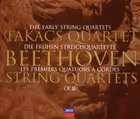
Beethoven: String Quartets, Op. 18, Takács Quartet
- Composer
- Beethoven
- Artist
- Takács Quartet
- Label
- Decca
- Catalogue
- 470 848-2
- Reviewed by
- Sandy Matheson
The release of the Rasumovsky Quartets by the Takács Quartet in 2002 could hardly have been a more auspicious start to their first Beethoven cycle on record; it was a shoo-in for that year’s Gramophone Chamber Music Award. Their new set of the Op. 18 quartets, rather misleadingly billed as ‘The Early Quartets’, is of a similarly exalted standard. Indeed, my comparative listening failed to unearth a version to better it.
It’s partly a question of their sound; they employ nervy, quick vibrato, and favour relatively fat-free, tangy sonorities that suit Beethoven’s dramatic, witty music perfectly. They also risk dangerously quick, swashbuckling tempi for the allegros, it’s surprising how many rival quartets content themselves with jog-trot tempi. Movements such as the Allegro molto, quasi presto of the G major quartet are exhilarating in the Takács’ hands, for instance. The first movement of the F major quartet is launched like a tightly-coiled spring and throughout the set the fast music is propelled by taut, tensile rhythms.
‘Slow’ movements are actually quite rare in the Op. 18 set; there is only one true adagio (in the B flat quartet), and that turns out to be an introduction to the shadow-flecked finale. The Takács find a tempo that maximises the depth and atmosphere of this remarkable music, without becoming becalmed as the Quartetto Italiano do in their recording, one of the Italians’ rare blemishes in a generally finely-judged set.
The ‘bread and butter’ of quartet playing, intonation, ensemble, balance, are entirely mastered; the often tricky first violin writing sounds like a walk in the park as played by Edward Dusinberre. Andrew Keener’s production ensures warmth without any fuzziness. I can’t wait for the final volume, due out in the autumn.
About the quartet
The Takács Quartet was founded in 1975 by four students at Budapest’s Franz Liszt Academy, and made its international name after winning first prize and the Critics’ Prize at the 1977 Evian International Competition. By the time of this Beethoven cycle, recorded across 2002 to 2004, the ensemble had become quartet-in-residence at the University of Colorado and its personnel had shifted from entirely Hungarian to a roughly even mix of Hungarian and British players, with Edward Dusinberre holding the first-violin chair alongside founding cellist András Fejér. The completed cycle marked the end of the quartet’s long association with Decca; they moved to Hyperion Records once the project was finished.
A note on this page
Originally published by Sandy Matheson, recovered from mmmusic's own archive and reproduced here as the critic wrote it.
Questions about this recording
What preceded this recording in the Takács Quartet's Beethoven cycle?
Their 2002 recording of the Rasumovsky Quartets, which won that year's Gramophone Chamber Music Award, this Op.18 set continues the same cycle.
Why is it billed as 'The Early Quartets'?
Op.18 comprises Beethoven's first set of string quartets, written before the Rasumovsky quartets, though the review notes the 'Early Quartets' label is somewhat misleading given how assured the writing already is.
How does the Takács approach compare to rivals like the Quartetto Italiano?
The review singles out the Takács's quicker, more taut tempos as a strength, contrasting them with the Quartetto Italiano's tendency to become becalmed in the B flat quartet's slow introduction.
Is this recording still available to buy?
Yes, Decca's catalogue number 470 848-2 remains findable through classical retailers. We don't run an in-house shop, so we link out to Amazon and Discogs below.


