CD Review
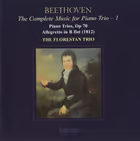
Beethoven: The Complete Music for Piano Trio, Vol.1, Op.70 Trios & Allegretto WoO 39
- Composer
- Beethoven
- Artist
- The Florestan Trio
- Label
- Hyperion
- Catalogue
- CDA 67327
- Reviewed by
- Sandy Matheson
The Florestan Trio begin their survey of Beethoven’s works for the medium with a coupling of the Op.70 trios, composed immediately after the completion of the Pastoral Symphony in the summer of 1808. They are sharply contrasting works. The explosive, dramatic Ghost Trio, so called because of its extraordinary slow movement with its creepy chromatic tremolos, is one of Beethoven’s most popular chamber works. Its companion, the gracious and sunny E flat major Trio, deserves quite as much attention.
Richard Wigmore, in his excellent liner note, suggests the work may have been a homage to Beethoven’s former teacher Haydn; certainly, the warm-hearted, humorous finale has a Haydnesque character. It’s a wonderful piece, and receives a wonderful performance from the Florestans. Susan Tomes’s fluent, unassumingly virtuosic playing, as expressive as it is structurally astute, never overwhelms her colleagues, even when Beethoven takes the cello into its baritone register.
The Florestans also give one of the finest versions on record of the Ghost Trio. The return to daylight after the weird happenings in the slow movement is beautifully managed, its numerous jokes perfectly timed. Some of the credit for this outstanding record should go to Andrew Keener’s production; the recorded sound, it was recorded in the Henry Wood Hall, really couldn’t be bettered. Don’t miss it!
About the ensemble
The Florestan Trio was formed in London in 1995, when pianist Susan Tomes and cellist Richard Lester, both previously of the piano quartet Domus, joined violinist Anthony Marwood. Their 1999 recording of Schumann’s first two piano trios won that year’s Gramophone Award for chamber music, and the same year the trio received the Royal Philharmonic Society’s Chamber Ensemble award. Over sixteen years together the group built a repertoire spanning Mozart, Schubert, Mendelssohn and Dvořák alongside the complete trios of Beethoven and Brahms, before giving their final concerts at London’s Wigmore Hall in January 2012.
A note on this page
Originally published by Sandy Matheson, recovered from mmmusic's own archive and reproduced here as the critic wrote it.
Questions about this recording
What's on this disc?
Beethoven's two Op.70 piano trios, the 'Ghost' Trio in D major and the Trio in E flat major, plus the short Allegretto in B flat, WoO 39, opening the Florestan Trio's Hyperion survey of Beethoven's complete piano trios.
Why is the D major trio nicknamed the 'Ghost'?
For its unusual, unsettling slow movement, built from creepy chromatic tremolos, one of Beethoven's most distinctive and popular chamber-music movements.
Is there a connection to Haydn on this disc?
The liner notes by Richard Wigmore suggest the E flat major Trio may be a homage to Beethoven's former teacher Haydn, pointing to the warm-hearted, humorous character of its finale.
Is this recording still available to buy?
Yes, Hyperion's catalogue number CDA 67327 remains findable through classical retailers. We don't run an in-house shop, so we link out to Amazon and Discogs below.
What's this release's catalogue number?
Hyperion's CDA 67327, the first volume in the Florestan Trio's complete Beethoven piano trio cycle for the label, worth knowing if you're after the rest of the set rather than just this disc.


