CD Review
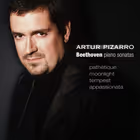
Beethoven: Piano Sonatas Opp.13, 27/2, 31/2 & 57, Artur Pizarro, piano
- Composer
- Beethoven
- Artist
- Artur Pizarro, piano
- Label
- Linn Records
- Catalogue
- CKD 209
- Reviewed by
- Sandy Matheson
After a period of inactivity in the recording studio (due to the collapse of Collins Classics), Artur Pizarro has produced a distinguished record of popular Beethoven sonatas. This is the first release in a series for Linn Records; future CDs will include music by Schumann and Rachmaninov.
The first thing that strikes one about his new Beethoven album is the sound of his chosen instrument, a Blüthner, whose slim, slightly citric treble and light bass seem ideal for Beethoven. Linn’s engineering, the recording was made in Potton Hall in Suffolk, is stunningly realistic. The rapid decay of Pizarro’s instrument allows for greater clarity than one often finds in such passages as bars 243-271 in the Tempest’s finale; earlier in this piece he catches the vocal quality of the writing.
Pizarro drives the finales of all four sonatas hard, the final movement of the Tempest is taken rather faster than the Allegretto marking might suggest, but not implausibly so. During the course of a generally impressive performance of the Appassionata sonata, his big technique allows him to accelerate to a demonic Presto from a fast basic tempo in the finale. This fine album earns its place in a crowded market; I’d very much like to hear more Beethoven from Pizarro.
About the pianist
Born in Lisbon in 1968, Artur Pizarro gave his first public performance at the age of three, having been introduced to the piano by his grandmother. He studied for over fifteen years with Sequeira Costa, himself a pupil of Vianna da Motta and Edwin Fischer, before further study in Paris with Aldo Ciccolini. Pizarro’s international career began in earnest after he won first prize at the 1990 Leeds International Pianoforte Competition, and he has since received several honours from his native Portugal for services to music and culture, alongside recognition as a Yamaha Artist. He has received several honours from his native Portugal for services to music and culture, including the Portuguese Press Award, the Portuguese Society of Authors award, the Medal of Culture of the City of Funchal and the Medal of Cultural Merit from the Portuguese government. The four sonatas gathered on this Linn disc, the “Pathétique” (Op. 13), the “Moonlight” (Op. 27 No. 2), the second sonata of Op. 31 (the “Tempest”) and the “Appassionata” (Op. 57), are among the most frequently recorded in the entire piano repertoire, spanning roughly a decade of Beethoven’s early-to-middle output and each carrying a popular nickname the composer himself never sanctioned.
A note on this page
Originally published by Sandy Matheson, recovered from mmmusic's own archive and reproduced here as the critic wrote it.
Questions about this recording
Which sonatas are on this disc?
Four of Beethoven's most popular sonatas: No.8 'Pathétique' (Op.13), No.14 'Moonlight' (Op.27/2), No.17 'Tempest' (Op.31/2) and No.23 'Appassionata' (Op.57).
Why was this Pizarro's first release in some time?
The review notes a period of inactivity in the recording studio caused by the collapse of Collins Classics, the label Pizarro had recorded for previously, this Linn disc marked the start of a new series that went on to include Schumann and Rachmaninov.
What instrument did Pizarro play for this recording?
A Blüthner piano, whose slim, slightly citric treble and light bass the review singles out as especially well-suited to Beethoven.
Is this recording still available to buy?
Yes, Linn's catalogue number CKD 209 remains findable through classical retailers. We don't run an in-house shop, so we link out to Amazon and Discogs below.


