CD Review
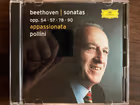
Beethoven: Piano Sonatas Opp.54, 57, 78 & 90, Maurizio Pollini, piano
- Composer
- Beethoven
- Artist
- Maurizio Pollini, piano
- Label
- Deutsche Grammophon
- Catalogue
- DG 474 4512 (2CD)
- Reviewed by
- Sandy Matheson
Nothing remotely like the Appassionata Sonata had ever been conceived for the piano before, even by Beethoven himself, who always liked to push at the boundaries of the possible in his music. Even today, it remains one of the supreme technical challenges to the pianist. Maurizio Pollini has waited until his sixtieth year before committing it to disc, a time when many a virtuoso would have long since dropped it from their repertoires.
His technique remains as formidable as ever it was; not many pianists could deliver the rocketing chordal passage in the first movement’s coda with Pollini’s furious precision. Berlioz’s famous comment about the Fifth Symphony’s Scherzo, “like the gaze of a mesmeriser”, can be pressed into service for Pollini’s awesomely still playing in the following variations, while the finale is properly tempestuous while observing Beethoven’s Allegro, ma non troppo qualification. Amongst other things, Pollini includes a lovely account of the F sharp major sonata.
I haven’t always responded positively to Pollini in Beethoven, but this recording finds the great Italian pianist at his most committed, and there is much to admire here. DG offers a “limited edition” second CD including live performances of the Appassionata and Op.78 sonatas. The end of the F sharp sonata catches the audience totally unawares; Beethoven still retains the ability to surprise!
About the sonatas
Opp.54, 57, 78 and 90 span an unusually wide stretch of Beethoven’s middle-to-late piano writing. The two-movement Op.54 is the least often programmed of the four, sitting between the Waldstein and the Appassionata in his catalogue and often overshadowed by its more famous neighbour. The Appassionata (Op.57) itself is the emotional and technical centre of gravity here, one of the three sonatas Beethoven himself considered his finest alongside the Moonlight and Op.31 No.2. Op.78, a compact two-movement work dedicated to Countess Therese von Brunsvik, is comparatively intimate and lyrical, while Op.90 marks a turn toward the more inward, exploratory writing that characterises Beethoven’s late period.
About the performer
Maurizio Pollini (1942–2024) was one of the defining pianists of the postwar era, launched to international attention after winning the 1960 International Chopin Piano Competition in Warsaw at just eighteen. Alongside his celebrated Chopin, he became closely associated with Beethoven throughout his career, recording and re-recording the sonatas for Deutsche Grammophon over several decades, including a complete cycle of all 32. His playing was consistently described as combining exacting technical control with an unusually cool, architectural clarity, qualities this recording, made well into his sixth decade as a performer, still shows in full.
A note on this page
Originally published by Sandy Matheson, recovered from mmmusic's own archive and reproduced here as the critic wrote it.
Questions about this recording
Which sonatas are on this recording?
The main disc pairs Opp.54, 57 (the Appassionata) and 90. DG's limited-edition second CD adds live performances of the Appassionata and Op.78, recorded separately from the studio takes.
Why is the Appassionata considered so demanding?
Beethoven pushed the technical and expressive limits of the piano of his day in the Appassionata, long stretches of rapid figuration, wide dynamic extremes and a famously punishing coda in the first movement, and it remains one of the most physically demanding works in the mainstream repertoire.
Had Pollini recorded Beethoven's sonatas before this?
Yes, Pollini recorded and re-recorded Beethoven across his career, including a complete cycle of the 32 sonatas for Deutsche Grammophon. This disc, made in his sixtieth year, revisits repertoire he'd first committed to disc decades earlier.
Is this recording still available to buy?
Yes, DG's catalogue number 474 4512 remains findable through the usual classical retailers. We don't run an in-house shop, so we link out to Amazon and Discogs below.


