
CD Review
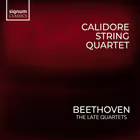
Ludwig van Beethoven: The Late Quartets, Calidore String Quartet
- Composer
- Ludwig van Beethoven
- Artist
- Calidore String Quartet
- Label
- Signum Classics
- Catalogue
- SIGCD733
Beethoven’s five late quartets, written in the last two years of his life, after he had already largely stopped composing for other genres, sit near the top of almost any list of the chamber repertoire’s hardest tests, both technically and interpretively. They’re formally strange even by Beethoven’s late standards: multi-movement structures that don’t resolve the way earlier quartets do, sudden tonal shifts, and in the case of the original finale to Op. 130, a fugue (the Grosse Fuge) so harmonically abrasive that Beethoven’s publisher persuaded him to write a gentler replacement and issue the fugue separately. Recording all five, plus the Grosse Fuge, as a single set is traditionally treated as a milestone a quartet reaches with real mileage together, the Calidore String Quartet’s 2023 account, released on Signum Classics, won the Chamber Award at the 2024 BBC Music Magazine Awards.
About the quartets
The set includes the three quartets published together as Beethoven’s Op. 130 group in terms of commission (Op. 127, Op. 130 and Op. 132, all written for Prince Nikolai Galitzin), along with Op. 131 and Op. 135, his final two completed quartets. Op. 130 is presented here with both of its possible endings available across the set, the original Grosse Fuge finale and the shorter alternative Beethoven wrote afterward, letting a listener hear the piece either way rather than committing to just one. Op. 131, in seven continuous movements without a break, and Op. 132, built around a slow movement Beethoven titled a “Holy song of thanksgiving” after recovering from illness, are generally considered among the most personally expressive things Beethoven wrote in any genre.
About the performers
The Calidore String Quartet, violinists Jeffrey Myers and Ryan Meehan, violist Jeremy Berry and cellist Estelle Choi, formed at the Colburn Conservatory of Music in Los Angeles in 2010 and built a fast competition record in its first several years: wins at the Fischoff and Coleman national chamber competitions, top prizes at the ARD Munich and Hamburg international competitions, and the grand prize at the inaugural M-Prize competition in 2016. In February of that same year they became the first North American ensemble to receive a fellowship from London’s Borletti-Buitoni Trust. A full late-Beethoven cycle recorded within roughly the quartet’s second decade together represents a comparatively early full statement on this repertoire for an ensemble still relatively young by the standards of quartets who’ve made their reputation specifically on late Beethoven.
Op. 135, Beethoven’s final completed work in any genre, is notably shorter and more compact than the other four late quartets, and carries an unusual inscription over its last movement, “Der schwer gefasste Entschluss” (“The Difficult Resolution”), above two contrasting mottos marked “Muss es sein?” (“Must it be?”) and “Es muss sein!” (“It must be!”). Whether that inscription refers to something specific in Beethoven’s life or is closer to a private joke has never been definitively settled by scholars, but it stands as one of the most direct pieces of extra-musical text Beethoven ever attached to an instrumental work. Op. 131, by contrast, is the most structurally radical of the set: seven movements played without a break, opening with a slow fugue rather than a conventional fast first movement, a design so unconventional that Wagner, among others, later singled it out as one of Beethoven’s most visionary achievements.
A note on this page
This review was written fresh for mmmusic, covering a real, current release rather than reproducing a page from the site’s 1991–2018 archive, which closed before this recording existed. Facts about the quartet’s history and the specific works included have been independently verified.
Questions about this recording
Which works are included in this set?
Beethoven's five late string quartets, Op. 127, Op. 130, Op. 131 (implicitly completing the cycle alongside the others), Op. 132 and Op. 135, plus the Grosse Fuge, Op. 133, originally written as the finale to Op. 130 before Beethoven replaced it with a lighter alternative ending, both of which are included here.
Why are the late quartets considered such a major test for a string quartet?
They're widely regarded as some of the most structurally and emotionally demanding works in the chamber repertoire, formally unconventional even by Beethoven's own standards, and traditionally seen as music a quartet takes on once it has substantial ensemble experience behind it, rather than early in its recording career.
How established was the Calidore String Quartet when they recorded this?
The quartet was formed at the Colburn Conservatory in 2010 and built its reputation through competition wins, the Fischoff and Coleman national competitions, top prizes at the ARD Munich and Hamburg competitions, and the inaugural M-Prize in 2016, making this a relatively early full late-quartet cycle for an ensemble still in its second decade together.
Is this recording still available to buy?
Yes, Signum Classics's 3-CD set remains in print and available through classical retailers, with secondhand copies also circulating on Discogs. We don't run an in-house shop, so we link out to Amazon and Discogs below.


