CD Review
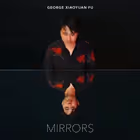
Ravel, Rachmaninov, Tailleferre, Dutilleux, Chin, Andres, Waley-Cohen: Mirrors
- Composer
- Ravel, Rachmaninov, Tailleferre, Dutilleux, Chin, Andres, Waley-Cohen
- Artist
- George Xiaoyuan Fu, piano
- Label
- Platoon (self-released)
Debut solo piano albums usually pick a lane, a single composer, a single era, sometimes a single work paired with something more obscure to fill out the running time. George Xiaoyuan Fu’s MIRRORS, self-released digitally in 2022, does something more deliberately essayistic: it takes Ravel’s five-movement suite Miroirs as its structural anchor and builds an entire recital around the idea of musical reflection, pieces that quote, transcribe, or respond to earlier music, stretching from Rachmaninov and the French composer Germaine Tailleferre through to living composers Unsuk Chin, Timo Andres and Freya Waley-Cohen. It won the Newcomer Award at the 2024 BBC Music Magazine Awards.
About the programme
Ravel’s Miroirs (1904–05) is itself a suite explicitly built on the idea of reflection and observation, each of its five movements evokes a different scene or mood, from moths circling a lamp to a boat on open water. Fu uses it as the organising idea for the rest of the disc rather than presenting it as a self-contained centrepiece: music by Rachmaninov and Tailleferre sits alongside Henri Dutilleux, and works by two living composers, Unsuk Chin and Timo Andres, along with British composer Freya Waley-Cohen, extend the idea of musical reflection into the present rather than treating it as a purely historical device. That range, Romantic-era Rachmaninov through to contemporary composers still actively working, is unusually wide for a debut recital, and reflects a specifically curatorial approach rather than a straightforward technical showcase.
Ravel’s suite itself is worth setting out in a little detail, since it’s the disc’s organising idea. Its five movements are Noctuelles (“Night Moths”), Oiseaux tristes (“Sad Birds”), Une barque sur l’océan (“A Boat on the Ocean”), Alborada del gracioso (a Spanish-flavoured “Jester’s Morning Song”) and La vallée des cloches (“The Valley of Bells”), each dedicated to a different member of Les Apaches, the informal circle of artists and writers Ravel belonged to in early-1900s Paris, and each built around a single vivid image rather than a conventional sonata-form structure. That format, a set of short, independently titled character pieces unified by a single idea rather than a continuous narrative, is itself echoed in how Fu structures the rest of the album: individual short works by different composers, each responding in its own way to the same underlying idea of musical reflection, rather than a single continuous musical argument.
About the performer
George Xiaoyuan Fu is an American pianist whose profile grew substantially around this release, The Arts Desk called him one of the most exciting young pianists of his generation, and BBC Music Magazine’s five-star review of MIRRORS praised playing “fuelled by a deep emotion and understanding of the repertoire.” Notably, the album was self-released and distributed digitally through Platoon rather than issued by an established classical label, winning a major magazine’s Newcomer Award without a label’s promotional backing is a real point of distinction for an artist this early in a recording career, and it’s part of why the album’s DIY release format is worth mentioning rather than treated as incidental.
A note on this page
This is a freshly written review, not a page recovered from mmmusic’s original 1991–2018 archive, the site had already closed by the time this album came out. Some specifics of this self-released digital album, full track-by-track programme details in particular, are less consistently documented across sources than a major-label release with a printed booklet would be; where we weren’t fully confident of a specific claim, we’ve kept the description general rather than guessing. As with any digital-only release, there’s no physical pressing to track down secondhand, streaming and download are the only ways to actually hear it.
Questions about this recording
What's the concept behind the album's title?
Ravel's five-movement piano suite Miroirs ("Mirrors") sits at the centre of the programme, and the rest of the recital is built around the idea of musical reflection, pieces that quote, transcribe or respond to other music, rather than being a conventional single-composer or single-era recital.
Which other composers are featured alongside Ravel?
Sergei Rachmaninov, Germaine Tailleferre, Henri Dutilleux, Unsuk Chin, Timo Andres and Freya Waley-Cohen, a deliberately wide spread from early-20th-century French and Russian repertoire through to living composers.
Was this a major-label release?
No, MIRRORS was self-released, distributed digitally through Platoon rather than issued by an established classical label, which makes its Newcomer Award recognition at the 2024 BBC Music Magazine Awards notable: it competed and won without a label's marketing infrastructure behind it.
Who is George Xiaoyuan Fu?
An American pianist described by The Arts Desk as one of the most exciting young pianists of his generation; MIRRORS was his debut album, and BBC Music Magazine's five-star review praised playing that was "fuelled by a deep emotion and understanding of the repertoire."


