
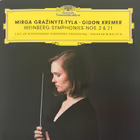
CD Review
Mieczysław Weinberg: Symphonies Nos. 2 & 21 ("Kaddish")
- Composer
- Mieczysław Weinberg
- Artist
- City of Birmingham Symphony Orchestra / Mirga Gražinytė-Tyla; Gidon Kremer, Kremerata Baltica
- Label
- Deutsche Grammophon
- Catalogue
- 483 6566
Mirga Gražinytė-Tyla’s first recording as the City of Birmingham Symphony Orchestra’s music director, pairing Weinberg’s Symphony No. 2 with his Holocaust-memorial Symphony No. 21 “Kaddish,” took Gramophone’s top overall prize — Recording of the Year — in 2020, beating every other classical release across every genre that year.
About the composer and the works
Mieczysław Weinberg’s biography sits behind almost everything distinctive about this music: born in Warsaw in 1919, he fled east into the Soviet Union in 1939 as the Nazis invaded Poland, and most of his family who remained were murdered in the Holocaust. He settled in Moscow, became a close friend of Shostakovich, and composed a large body of symphonies, string quartets and operas that remained largely unknown outside specialist Soviet-music circles for decades after his death in 1996. Symphony No. 2, an earlier, more compact work from 1946, contrasts with the much larger Symphony No. 21, composed in 1991 near the end of Weinberg’s life and explicitly subtitled “Kaddish” after the Jewish mourning prayer — a nearly hour-long memorial to the Holocaust’s victims, including members of his own family, that stands among the most directly personal statements in his output.
About the performers
Gražinytė-Tyla, a Lithuanian conductor who became the CBSO’s music director in 2016, has been closely identified with reviving interest in Weinberg’s music, and this recording — her first with the orchestra for Deutsche Grammophon — helped bring his work to a substantially wider international audience. Violinist Gidon Kremer, a longtime advocate for Soviet-era composers overlooked in the West, and his ensemble Kremerata Baltica join for parts of the programme, adding another performer whose own advocacy work helped keep Weinberg’s music alive well before this recording’s wider acclaim.
About the music itself
Symphony No. 2, scored for string orchestra alone, is comparatively compact and formally taut, written in 1946 in the immediate aftermath of the Second World War and reflecting the leaner, more classically disciplined idiom Weinberg favoured earlier in his career. Symphony No. 21 could hardly be more different in scale or intent: composed over four decades later, it runs to nearly an hour, employs a full orchestra, and unfolds as an extended, often harrowing meditation rather than a symphony in any conventional four-movement sense — closer in spirit to a requiem than to the earlier work on the same disc. Pairing the two lets a listener hear the full distance Weinberg travelled as a composer, from a promising young voice still working within recognisable Soviet symphonic conventions to an elder composer confronting the central trauma of his own life directly and without any formal restraint.
Why this recording changed things
Before this release, Weinberg’s reputation outside specialist Soviet-music circles rested mainly on a handful of chamber recordings and advocacy from musicians like Gidon Kremer. A major-label recording from a rising, high-profile conductor and an internationally prominent British orchestra, backed by Deutsche Grammophon’s distribution and marketing reach, did more to bring Weinberg’s music to a mainstream classical audience than most of what had come before it — a genuine case of a single recording measurably shifting a composer’s standing.
A note on this page
This review was written fresh to cover a real, award-winning recording — it’s new coverage rather than part of the archive recovered from mmmusic’s original 1991–2018 run, extending the same standard of factual reporting to what’s being recorded and recognised today.
Questions about this recording
Who was Mieczysław Weinberg?
A Polish-born Jewish composer who fled to the Soviet Union in 1939, lost most of his family in the Holocaust, and became a close friend and colleague of Shostakovich. His large output was largely neglected outside specialist circles for decades after his death in 1996, only gaining wider international attention from the 2010s onward.
What is Symphony No. 21 'Kaddish' about?
Composed in 1991 and subtitled 'Kaddish' after the Jewish mourning prayer, it's an explicit memorial to the victims of the Holocaust, including Weinberg's own family — one of his largest and most personal works, running to nearly an hour.
Why was this Gramophone's overall Recording of the Year, not just the orchestral category winner?
It won both the Orchestral Award and the top overall Recording of the Year prize in 2020 — the magazine's highest honour, chosen from every category winner across the whole year's releases, not just a strong result within one genre.
Is this recording still available to buy?
Yes — Deutsche Grammophon's catalogue number 483 6566 remains available through the label and classical retailers. We don't run an in-house shop, so we link out to Amazon and Discogs below.


