CD Review
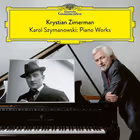
Karol Szymanowski: Piano Works, Krystian Zimerman, piano
- Composer
- Karol Szymanowski
- Artist
- Krystian Zimerman, piano
- Label
- Deutsche Grammophon
- Catalogue
- 486 3008
Krystian Zimerman has built one of the most respected pianistic reputations of the last half-century while recording comparatively little of it, long gaps between releases, and famously exacting personal standards about what actually reaches disc. His Szymanowski album for Deutsche Grammophon, released in September 2022 to mark the 140th anniversary of the composer’s birth, won the Piano Award at the 2023 Gramophone Classical Music Awards, and carries an unusual production history even by Zimerman’s own standards: the Masques were recorded in Copenhagen in 1994, nearly thirty years before the rest of the programme was set down in Fukuyama in 2022 and the complete album finally released.
The four works, the early 9 Preludes, Op. 1; Masques, Op. 34; the 20 Mazurkas, Op. 50; and the Variations on a Polish Folk Theme, Op. 10, trace a good part of Szymanowski’s development as a piano composer, from an early, still Romantic-leaning voice through to the more harmonically adventurous, folk-inflected writing of his maturity.
About Szymanowski’s piano writing
Karol Szymanowski (1882–1937) is the most significant Polish composer between Chopin and the mid-20th-century generation, and his piano music moves through several distinct phases across this programme. The early Preludes, Op. 1, sit closer to late-Romantic models, Chopin and Scriabin are both audible influences, while Masques and the Mazurkas show a harder-edged, more chromatically adventurous language shaped by his engagement with Polish highland folk music and, in the Mazurkas specifically, a direct dialogue with Chopin’s own use of the same dance form a century earlier. Programming all four works together gives a fuller picture of that development than any single piece could on its own.
About the performer and this recording’s history
Zimerman’s Polish nationality and his own long, documented engagement with Szymanowski’s music, a relationship stretching back decades before this specific album’s release, make this a genuinely personal project rather than a repertoire choice picked up for a themed anniversary disc. The nearly thirty-year gap between recording the Masques and completing the rest of the programme is itself characteristic: Zimerman has recorded far less than his stature would suggest since the late 1990s, and has been open about controlling the timing and conditions of his own releases rather than working to a label’s usual schedule. That the earlier Copenhagen sessions were considered good enough to sit alongside sessions recorded nearly three decades later says something about how exacting, and how consistent, his own standards have remained across that span.
About the anniversary framing
Deutsche Grammophon timed the release to Szymanowski’s 140th anniversary, but the disc doesn’t read as an occasional tribute assembled to fit a marketing calendar, Zimerman’s own relationship with this repertoire, and the decades-old Copenhagen sessions folded into the final release, point to a project driven by the pianist’s own long engagement with the composer rather than by the anniversary itself. Anniversary years are a common trigger for classical labels to greenlight a specific recording; what’s less common is a pianist bringing sessions from three decades earlier into the finished album rather than simply re-recording everything fresh to a single studio schedule.
A note on this page
This review was written fresh by the mmmusic team about a real, current recording, not reproduced from an original mmmusic critic, it’s new coverage rather than part of the site’s recovered 1991–2018 archive. The unusual 1994/2022 recording history and the Gramophone Piano Award were both independently checked rather than assumed.
Questions about this recording
What's on this recording?
Four works by Karol Szymanowski: the 9 Preludes, Op. 1; Masques, Op. 34; the 20 Mazurkas, Op. 50; and the Variations on a Polish Folk Theme, Op. 10, spanning most of his output for solo piano.
Why did this recording take so long to release?
The Masques were actually recorded in Copenhagen back in 1994, nearly three decades before the rest of the programme was recorded in Fukuyama in 2022 and the full album finally released, consistent with Zimerman's famously slow, selective approach to releasing recordings.
Is Krystian Zimerman known for recording a lot?
No, he's recorded comparatively little relative to his stature, particularly between the late 1990s and late 2010s, and is known for being unusually exacting about when and how his recordings are released.
Did this album win an award?
Yes, it won the Piano Award at the 2023 Gramophone Classical Music Awards.


