CD Review
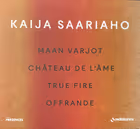
Kaija Saariaho: Château de l'âme, Maan varjot, Offrande & True Fire
- Composer
- Kaija Saariaho
- Artist
- Faustine de Monès, Davóne Tines, Anssi Karttunen, Olivier Latry; Chorus of Radio France, French National Orchestra & French Radio Philharmonic
- Label
- Radio France
- Catalogue
- FRF072
This Radio France release brings together four works by Kaija Saariaho, Château de l’âme, Maan varjot, True Fire and Offrande, spanning soprano-and-orchestra, solo organ, baritone-and-orchestra and solo cello writing, and won the Contemporary Award at the 2024 Gramophone Classical Music Awards. It arrived the year after Saariaho’s death on 2 June 2023, giving what was already a genuinely representative portrait of her range as a composer an additional, unplanned weight as a document of her work.
Saariaho, a Finnish composer based for most of her career in Paris, was among the most performed and critically discussed composers of contemporary classical music over the last twenty-five years, with a catalogue spanning orchestral works, chamber music, electronic and spectral composition, and opera, including L’Amour de loin, which in 2000 made her one of only a small number of women to have an opera staged at the Metropolitan Opera in New York, and which has continued to be staged internationally in the years since. Her music is often associated with the “spectral” compositional tradition that grew out of French composition in the 1970s, using detailed analysis of the acoustic properties of sound itself, overtones, timbre, the fine internal structure of a single note, as raw compositional material, though her own voice within that tradition became distinctively her own well beyond its original technical starting point.
Saariaho’s own training runs directly through some of the most significant institutions in late-twentieth-century contemporary composition: she studied with Paavo Heininen at the Sibelius Academy in Helsinki, then with Klaus Huber and Brian Ferneyhough at the Freiburg Musikhochschule, before moving to Paris in 1982 to study computer music at IRCAM, the electro-acoustic research institute where she remained based, on and off, for the rest of her career. That IRCAM background, working directly with technology for analysing and manipulating sound at a granular level, is a large part of where the distinctive, luminous orchestral and electronic textures across her output originate, even in the purely acoustic works featured on this particular disc. Her honours over the following decades included the Grawemeyer Award, the Wihuri Sibelius Prize, the Nemmers Prize and the 2013 Polar Music Prize, alongside the international opera career already noted above.
About the four works
The four pieces on this disc were chosen to represent real breadth across Saariaho’s output rather than focusing on a single period or genre. Château de l’âme, for soprano and orchestra, and True Fire, for baritone and orchestra, put two different solo voices against large orchestral forces, the Radio France forces here spanning both the French National Orchestra and the French Radio Philharmonic across the disc’s different pieces. Maan varjot, for solo organ, and Offrande, for solo cello, move to the opposite extreme: a single instrumental voice, without the orchestral scale of the other two works, letting a listener hear Saariaho’s harmonic and textural language stripped down to a single line.
About the performers
Soprano Faustine de Monès and baritone Davóne Tines take the two vocal-orchestral works; cellist Anssi Karttunen, a longtime and frequent collaborator with Saariaho across much of her career, performs Offrande; and organist Olivier Latry, titular organist of Notre-Dame de Paris, performs Maan varjot. The combined forces of the Chorus of Radio France, the French National Orchestra and the French Radio Philharmonic across the disc reflect Radio France’s own role as one of the most significant institutional supporters of Saariaho’s music throughout her career, making this release as much an institutional tribute as an individual recording project.
A note on this page
This is a freshly written review of a real recording, not a page recovered from mmmusic’s archive of reviews from its original 1991–2018 run. We’re covering it as part of extending the site’s factual, verified coverage to significant recent releases, including this one’s added context as a posthumous tribute to a major contemporary composer.
Questions about this recording
Who was Kaija Saariaho?
A Finnish composer, based for most of her career in Paris, widely regarded as one of the most performed and influential composers of contemporary classical music of the last quarter-century. She died on 2 June 2023.
What four works are on this disc?
Château de l'âme (for soprano and orchestra), Maan varjot (for solo organ), True Fire (for baritone and orchestra) and Offrande (for solo cello), spanning both vocal-orchestral and solo instrumental writing across Saariaho's output.
What did this recording win?
The Contemporary Award at the 2024 Gramophone Classical Music Awards.
Who are the performers?
Soprano Faustine de Monès, baritone Davóne Tines, cellist Anssi Karttunen and organist Olivier Latry, with the Chorus of Radio France, the French National Orchestra and the French Radio Philharmonic, a genuinely large combined roster reflecting the range of forces across the four pieces.


