
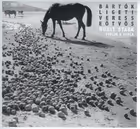
CD Review
Various composers: Bartók, Ligeti, Veress, Eötvös: Works for Violin & Viola
- Composer
- Bartók / Ligeti / Veress / Eötvös
- Artist
- Nurit Stark, violin and viola
- Label
- BIS
- Catalogue
- BIS-2416 SACD
An entirely unaccompanied recital, one player, no piano, no orchestra, is a demanding thing to build a whole disc around, and a demanding thing to win a major award with. Nurit Stark’s programme for BIS did exactly that, taking the Instrumental Award at the 2023 Gramophone Classical Music Awards, the same year BIS itself was named the magazine’s Label of the Year.
What holds the four works together isn’t simply that all four composers are Hungarian, but a direct, documented chain of teaching relationships across nearly a century: Béla Bartók taught Sándor Veress; Veress taught György Ligeti; and Ligeti was an early, formative influence on Péter Eötvös, recommending him for a place at Budapest’s Liszt Academy. Programming Bartók’s 1944 Sonata for Solo Violin, Veress’s 1935 Sonata per Violino Solo, Ligeti’s 1991–94 Sonata for Viola Solo and Eötvös’s 2019 Adventures of the Dominant Seventh Chord in one recital turns that lineage into something you can actually hear across 84 years of unaccompanied writing, rather than reading about it as a programme note.
About the works
Bartók’s Sonata for Solo Violin, written in 1944 during his final years in the United States and dedicated to Yehudi Menuhin, is the recital’s oldest and best-established piece, a substantial four-movement work that draws on Bach’s own unaccompanied violin writing as a formal model while staying firmly in Bartók’s own harmonic language. Veress’s earlier 1935 sonata, written while Bartók’s own influence on Hungarian composition was near its height, shows a younger composer working through similar unaccompanied-violin problems from inside that same tradition. Ligeti’s viola sonata, written across 1991–94 near the end of his life, moves the programme forward by half a century into a very different harmonic world, while Eötvös’s 2019 piece, the most recent work here by three decades, closes the recital with the chain’s most contemporary voice.
About the performer
Nurit Stark was born in Israel to a family originally from Romania and is now based in Germany, with a career built substantially around 20th- and 21st-century repertoire for solo strings rather than the more conventional Romantic concerto path many string soloists follow. Playing both violin and viola across this single recital, required by the Bartók, Veress and Eötvös works on violin and the Ligeti on viola, is itself a less common combination for a soloist to bring to one disc, and one that suits a programme specifically built around a single instrumental-writing lineage rather than a mixed-instrument survey.
About the label
BIS, the Swedish label founded and long run by Robert von Bahr, has built a reputation across four decades for exactly this kind of specialist, well-researched repertoire choice rather than chasing more commercially obvious programming, a recital built entirely around unaccompanied string writing linked by a documented teaching lineage is a genuinely BIS-shaped project. Being named Gramophone’s Label of the Year in the same year this specific disc won its own category award wasn’t a coincidence of a single strong release; it reflected a broader pattern across the label’s output that this recording is a representative, rather than exceptional, example of.
A note on this page
This review was written fresh by the mmmusic team about a real, current recording. It isn’t reproduced from an original mmmusic critic and sits outside the site’s recovered 1991–2018 archive. An earlier working note for this page had the wrong composers and label; the real programme (Bartók/Ligeti/Veress/Eötvös, BIS, not Kodály/Weiner on ECM) and the real Gramophone Instrumental Award were confirmed directly against the released disc before writing this page.
Questions about this recording
What's the connecting idea across this recital?
All four works are by Hungarian-rooted composers linked by direct teacher-to-student relationships across generations: Béla Bartók taught Sándor Veress, who taught György Ligeti, who was an early formative influence on Péter Eötvös.
What's actually on the disc?
Bartók's Sonata for Solo Violin, Sz.117 (1944); Ligeti's Sonata for Viola Solo (1991–94); Veress's Sonata per Violino Solo (1935); and Eötvös's Adventures of the Dominant Seventh Chord for Solo Violin (2019), spanning 84 years of unaccompanied writing for the two instruments.
Did this recording win an award?
Yes, it won the Instrumental Award at the 2023 Gramophone Classical Music Awards, the same year BIS was named the magazine's Label of the Year.
Who is Nurit Stark?
An Israeli-born violinist and violist, from a family originally from Romania, based in Germany, with a particular reputation for 20th- and 21st-century repertoire for solo strings.


